


What Should Buyers Consider Before Selecting a Slurry Pump Seal?
Slurry pump sealing should never be treated as a small accessory decision. In abrasive, high-solids, or chemically aggressive applications, the seal is one of the first components to show whether the pump system was properly specified. The right seal depends on the slurry, solids concentration, particle size, abrasiveness, pressure, temperature, flush or barrier plan, pump design, and maintenance environment.
A mechanical seal that works well in clean water can fail quickly in slurry service if abrasive particles enter the seal faces, if the seal chamber overheats, if springs or dynamic elements become packed with solids, or if the flush plan cannot maintain a clean and stable sealing environment. This guide explains what buyers, engineers, and maintenance teams should evaluate before selecting a slurry pump seal and why long-term reliability depends on more than the seal part number alone.
Why Slurry Pump Sealing Is Commonly Overlooked
When buyers evaluate slurry pumps, the first questions usually focus on flow rate, head, pump size, material handling, motor power, or system layout. Those factors matter, but the sealing system often receives attention too late in the selection process. That creates problems because the seal is directly exposed to the same abrasive, unstable, and high-load conditions that make slurry pumping difficult in the first place.
In many facilities, the seal is selected after the pump has already been chosen. That can lead to a mismatch between the seal design and the actual application. A seal may be technically compatible with the pump, but still poorly suited for the slurry conditions, duty cycle, operating pressure, or maintenance realities of the site.
Common problems caused by overlooked sealing requirements include:
- Premature leakage around the shaft or seal chamber
- Accelerated seal-face wear from abrasive solids
- Solids packing around springs, faces, or dynamic components
- Overheating due to poor lubrication or inadequate flushing
- Repeated seal replacement without solving the root cause
- Unplanned downtime and higher maintenance labor
- Process leakage that creates safety, housekeeping, or compliance concerns
The larger issue is that seal failure is often treated as a seal-only problem. In slurry systems, it is frequently a system problem involving operating conditions, material behavior, flush design, seal configuration, installation quality, and maintenance practices.
Why Standard Pump Seals Often Struggle in Slurry Applications
A standard mechanical seal is designed to control leakage along a rotating shaft by maintaining a precise interface between rotating and stationary seal faces. A thin fluid film between the faces provides lubrication and helps control heat. In clean-water or light-duty service, that arrangement can perform reliably for long periods when properly installed and maintained.
Slurry changes the operating environment. Instead of a relatively clean and predictable fluid, the seal is exposed to suspended solids, variable density, abrasive particles, pressure fluctuations, vibration, and possible chemical attack. These conditions can interrupt the lubrication film, damage seal faces, increase friction, and shorten seal life.
The most common slurry-specific failure modes include:
1. Abrasive face wear. Fine or coarse solids can enter the seal interface and wear the lapped faces. Once the sealing surface is damaged, leakage usually increases and the failure accelerates.
2. Solids packing and fouling. Slurry can settle around springs, dynamic O-rings, or other moving components. When the seal cannot maintain proper closing force, leakage and instability follow.
3. Heat buildup. High-solids service can generate more friction and localized heat than the bulk process temperature suggests. Without proper lubrication, cooling, or barrier-fluid circulation, seal components can degrade quickly.
4. Chemical and elastomer attack. Corrosive slurry, chemical process fluids, or high-temperature conditions can damage elastomers and metallic components if materials are not selected for the actual environment.
5. Installation and alignment issues. Cartridge seals reduce installation risk, but any seal can fail early if the shaft, sleeve, chamber, or gland face is worn, misaligned, or improperly prepared.
What Buyers Should Evaluate Before Selecting a Slurry Pump Seal
There is no universal slurry seal that fits every application. The correct selection depends on the material being pumped, the pump design, operating conditions, and how the seal will be supported in the field. Buyers should evaluate the full sealing environment before choosing a seal configuration.
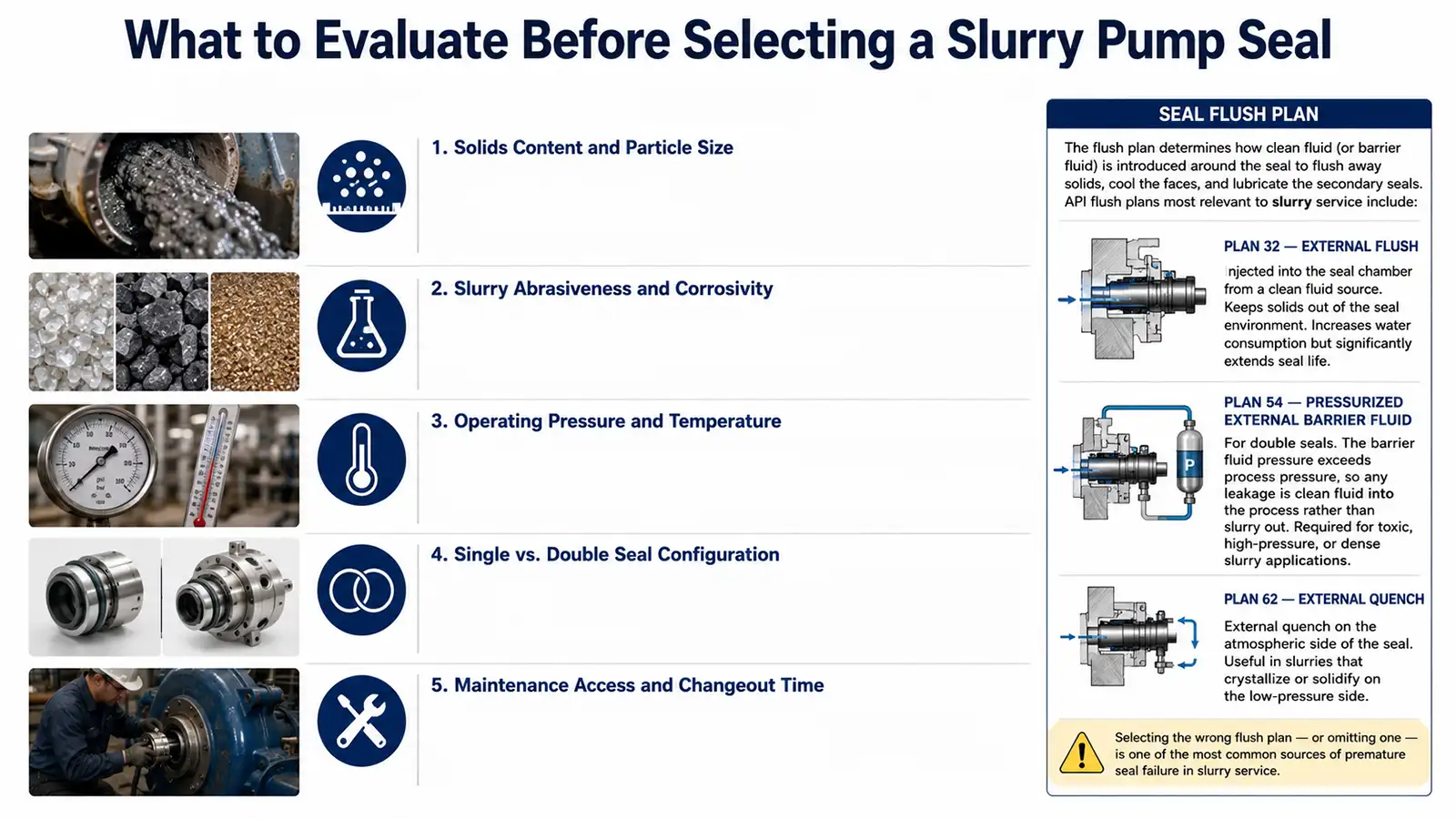
1. Solids Content and Particle Behavior
Solids concentration, particle size, particle shape, and particle hardness all influence seal life. Fine particles may enter the seal faces and cause gradual wear, while coarse or angular particles can create more aggressive abrasion. Dense or variable slurries may also require more robust sealing arrangements and stronger support systems than light-duty applications.
Buyers should gather basic material data before seal selection, including solids percentage, particle size range, abrasiveness, density, temperature, and whether the material tends to settle, harden, crystallize, or pack around components.
2. Abrasion and Corrosion Resistance
Slurry sealing is not only about stopping leakage. It is also about matching the seal-face materials, elastomers, and hardware to the material being pumped. Abrasive media may require harder seal-face combinations, while corrosive slurries may require specific elastomers or alloy hardware. The wrong material combination can shorten seal life even when the seal configuration is otherwise appropriate.
Because material compatibility is highly application-specific, face-material and elastomer recommendations should be confirmed against HydroMax product data and the actual process conditions before publishing any final specification.
3. Operating Pressure, Temperature, and Duty Cycle
Mechanical seals have pressure and temperature limits, but slurry applications often create more severe local conditions than the process data suggests. Friction at the seal faces, unstable suction conditions, pressure spikes, and intermittent dry-running events can all increase seal stress.
Duty cycle also matters. A seal in continuous operation has different risks than a seal that repeatedly starts and stops, sits idle in settled slurry, or operates in batch conditions where solids can dry or compact around the seal chamber.
4. Flush, Barrier, or Support System Requirements
The support system is one of the most important parts of slurry pump sealing. A seal may be properly designed, but it can still fail early if the flush or barrier system is not matched to the application. Clean fluid may be needed to lubricate the seal faces, remove heat, and keep abrasive solids away from the sealing interface.
Common support approaches include:
- External flush arrangements that introduce clean fluid into the seal chamber to help keep solids away from the faces.
- Dual or double seal arrangements with barrier or buffer fluid to isolate the process from the atmosphere.
- Plan 53 or Plan 54-style support systems where a controlled barrier-fluid system maintains pressure, circulation, and cooling for double mechanical seals.
- Quench or drain arrangements where crystallization, solids buildup, or atmospheric-side contamination must be managed.
The correct plan depends on process pressure, slurry severity, environmental requirements, available utilities, and the consequences of leakage. It should be treated as part of the seal selection, not as an optional add-on.
5. Single vs. Double Seal Configuration
Single seals may be appropriate in lighter-duty or less critical slurry applications where leakage consequences are low and a clean flush can be maintained. However, they expose the inboard seal faces more directly to the process fluid.
Double cartridge seals are often evaluated for more demanding slurry service because they can use a barrier or buffer fluid between two sets of seal faces. This helps isolate the seal faces from abrasive process fluid and gives operators more control over lubrication, cooling, and leakage management. The tradeoff is higher initial cost and the need for a properly designed support system.
6. Maintenance Access and Installation Quality
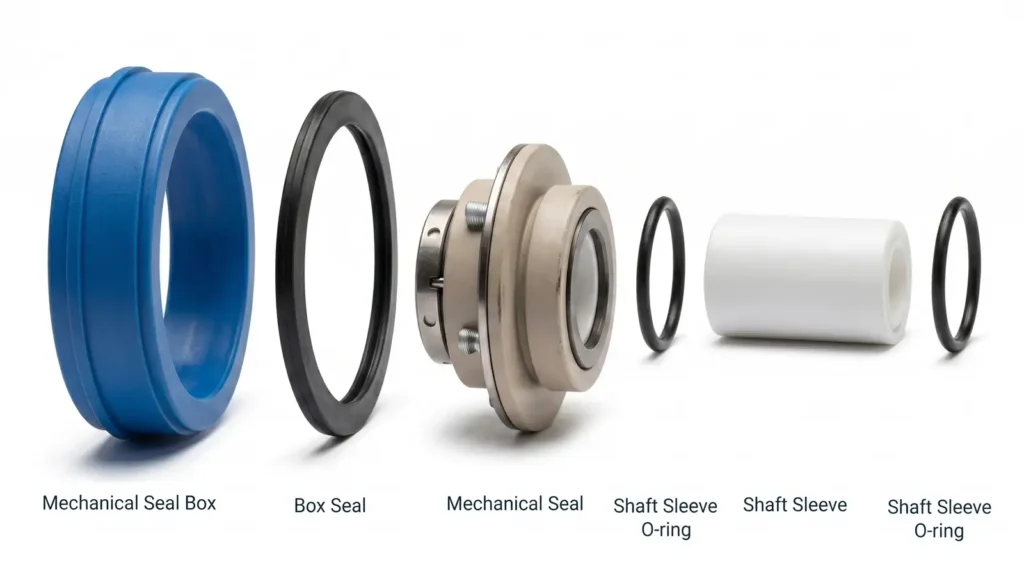
Installation quality has a major impact on seal life. Component seals require careful on-site assembly, measurement, and alignment. Cartridge seals are pre-assembled and preset, which reduces installation risk and can shorten changeout time.
In operations where maintenance crews are limited, downtime is expensive, or seal changes happen in difficult field conditions, a cartridge seal may reduce the chance of installation error and help make maintenance more repeatable.
Slurry Seal Configuration Comparison
| Configuration | Advantages | Limitations | Best-Fit Applications |
| Single cartridge seal with external flush | Simpler configuration; easier installation; lower initial cost than many dual-seal systems | Requires clean flush supply; less suited for severe abrasion, hazardous leakage, or unstable conditions | Light-to-moderate slurry service, wastewater, process water, less critical leakage applications |
| Double cartridge seal with barrier/buffer support | Improves isolation from slurry; supports better cooling and lubrication control; useful where leakage risk matters | Higher initial cost; requires support system, monitoring, and proper setup | Dense or abrasive slurry, chemical processing, high-consequence leakage, mission-critical pumps |
| Component seal | Flexible for retrofit or non-standard equipment; lower unit cost in some cases | Greater installation skill required; higher risk of setup error | Legacy pumps, retrofit situations, applications where cartridge dimensions are constrained |
| Dynamic or expeller-assisted sealing approach | Can reduce reliance on contacting seal faces during operation in some pump designs | May not seal at standstill; application-specific and requires engineering review | High-volume slurry systems where startup/shutdown leakage can be managed |
Note: This table is a general selection guide. Final seal configuration should be confirmed by HydroMax Seal based on the specific pump, slurry, pressure, temperature, leakage requirements, and support-system availability.
Where Slurry Mechanical Seals Often Work Well
Mechanical seals can perform well in slurry service when the seal configuration, materials, and support system are matched to the application. Strong application fits often include:
- Mining and mineral processing pumps handling tailings, ore-processing slurry, or process water with suspended solids
- Water and wastewater pumps handling sludge, grit, and solids-bearing effluent
- Chemical process pumps handling catalyst slurries, crystallizing fluids, lime slurry, or abrasive process media
- Power generation applications involving ash handling, FGD systems, or other solids-bearing fluids
- Pulp and paper applications where fiber-laden flows require careful seal and support-system evaluation
Applications That Need Extra Review
Some services require additional engineering review before selecting a seal. These include highly abrasive slurries, very dense slurries, fibrous materials that can wrap around components, corrosive slurries, intermittent duty cycles, or applications where leakage creates safety or environmental risk. In these cases, the best solution may involve a double cartridge seal, a specific barrier-fluid system, a special face-material combination, or upstream changes to reduce solids exposure at the seal chamber.
How HydroMax Seal Approaches Slurry Sealing
HydroMax Seal offers mechanical seals and seal support systems for demanding industrial applications where reliability, leakage control, and uptime matter. For slurry and solids-bearing service, the key is not only selecting a seal, but selecting the right seal environment.
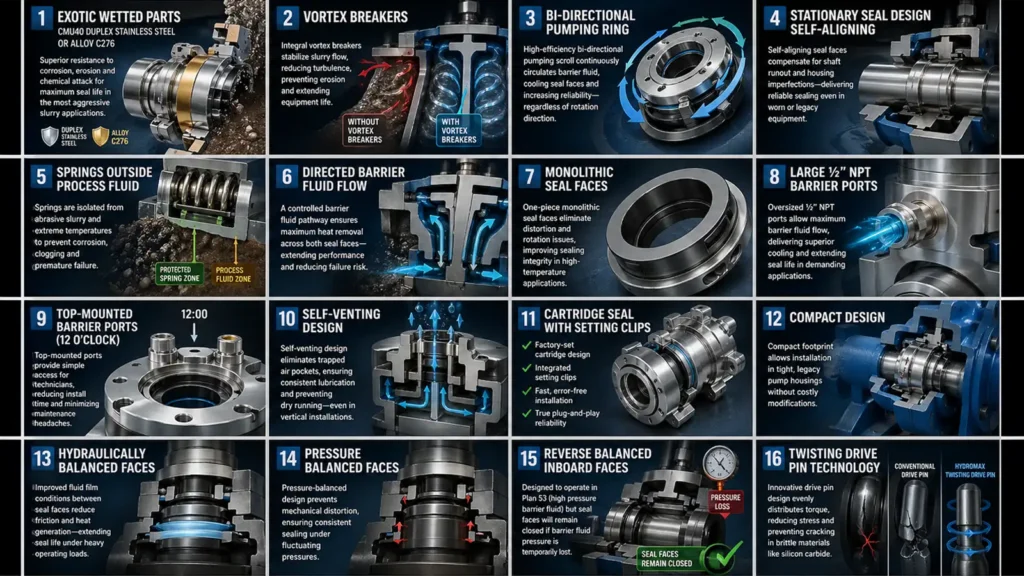
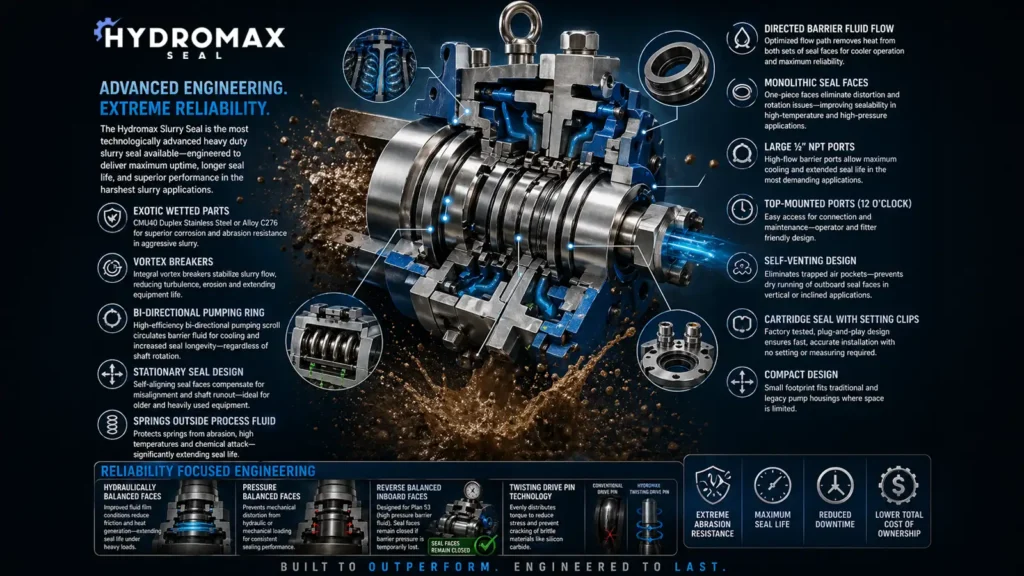
HydroMax public product information positions the SPS-610 as a slurry-duty double cartridge mechanical seal for process fluids containing solid particles. The product page describes an integral bi-directional barrier-fluid pumping ring, large barrier-fluid port orifices, vortex-breaker gland insert, self-aligning stationary face, multi-spring construction with springs outside the process fluid, and compatibility with Plan 53-style piping systems.
HydroMax also offers seal support systems and Plan 54 circulation systems designed to support double mechanical seals with controlled cooling, lubrication, and barrier-fluid circulation. These systems matter because slurry seal reliability often depends as much on the support plan as on the seal itself.
For buyers, the practical value is application review. HydroMax can help evaluate the material, pump type, operating pressure, temperature, solids exposure, leakage concerns, maintenance access, and support-system requirements before recommending a seal configuration.
Questions Buyers Should Ask Before Selecting a Slurry Pump Seal
- What material is being pumped, and how abrasive or corrosive is it?
- What is the solids concentration and particle size distribution?
- Does the slurry settle, harden, crystallize, or pack during shutdown?
- What are the normal and upset operating pressures and temperatures?
- Is leakage to atmosphere acceptable, controlled, or prohibited?
- Is clean flush water or barrier fluid available?
- Does the application require a single seal, double cartridge seal, or support system?
- How often will the pump start, stop, or sit idle with slurry in the seal chamber?
- Who will install and maintain the seal, and how much downtime is acceptable?
- Has a sealing engineer reviewed the full application instead of only the pump model?
Choosing the Right Slurry Seal Is a System Decision
Slurry pump sealing is often underestimated because the seal is physically small compared to the pump, motor, piping, and support equipment. But when the seal fails, the impact can be large. Leakage, unplanned maintenance, safety concerns, cleanup, downtime, and repeated replacement costs can quickly exceed the initial seal price.
The most reliable slurry sealing decisions are made by reviewing the full system: the pump, slurry, seal chamber, operating conditions, material compatibility, flush or barrier plan, and maintenance environment. A seal should not be selected only because it fits the shaft. It should be selected because it fits the application.
If your operation is dealing with recurring seal failure, short seal life, leakage, overheating, or uncertainty around flush requirements, the next step is an application review with the HydroMax Seal team.
Frequently Asked Questions
What is the most common reason slurry pump seals fail prematurely?
The most common causes are abrasive solids reaching the seal faces, inadequate flushing or barrier support, incorrect material selection, poor installation, and unstable pump operating conditions. In many cases, the seal is not the only problem. The full slurry system should be reviewed.
Do all slurry pumps need double mechanical seals?
No. Some lighter-duty or lower-consequence slurry applications may operate with a single cartridge seal and an appropriate flush. More severe slurry, hazardous leakage risk, higher pressure, or repeated failure history may justify a double cartridge seal with a barrier or support system.
What seal face materials are commonly evaluated for slurry service?
Harder face combinations such as silicon carbide or tungsten carbide are commonly evaluated for abrasive service, while carbon graphite may be more appropriate in clean-fluid applications. Final material selection should be confirmed against the slurry chemistry, abrasiveness, pressure, temperature, and HydroMax product data.
Why does the flush or barrier plan matter so much?
The flush or barrier plan helps control heat, lubrication, and solids exposure near the seal faces. Without the right support plan, abrasive particles can accumulate at the seal interface and cause early wear or leakage.
What is a Plan 54 system?
A Plan 54 system is a forced-circulation barrier-fluid system used with double mechanical seals. It helps circulate, cool, filter, and control barrier fluid so the seal faces operate in a cleaner and more stable environment. HydroMax offers Plan 54 circulation systems for demanding seal support applications.
Can a standard pump seal be used in slurry service?
Sometimes, but it is often not the best choice. Standard clean-service seals may not have the face materials, spring arrangement, clearances, or support-system requirements needed for abrasive slurry. A slurry-specific seal review is recommended.
What information should I provide before asking for a slurry seal recommendation?
Provide pump model, shaft size, process fluid, solids concentration, particle size, abrasiveness, temperature, pressure, duty cycle, flush availability, leakage requirements, failure history, and available maintenance access.
How can operators improve slurry seal life?
Operators can improve seal life by selecting the correct seal configuration, using compatible materials, maintaining proper flush or barrier conditions, preventing dry running, reducing vibration, monitoring temperature and pressure, and investigating recurring failures at the system level.