
EMD-30 – Teflon Bellows Mechanical Seal
EMD-30 – Teflon Bellows Mechanical Seal
Overview
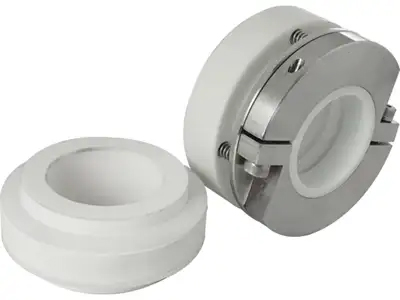
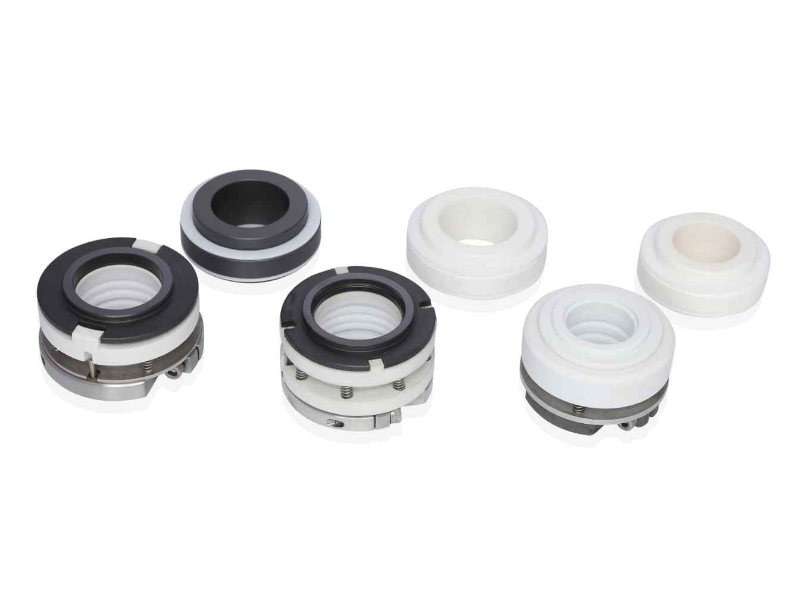
The EMD-30 is a MULTI-SPRING, TEFLON BELLOWS COMPONENT SEAL.
External Seal, Teflon Bellows, Parallel Shaft, Teflon clamped (No Elastomers), Multi-Spring & Collet Clamp Driven (Composite Bellow).
The seal has a number of design features, including a monolithic seal face, and is supplied with a stationary seat as standard.
Product Description
Technical Specifications
| Seal Shaft Sizes | 25mm – 100mm (1.000″ – 4.000″) |
| Inboard Seal Face Combination | GFT/Cer, GFT/SiC |
| Bellows | Composite GFT (Glass Filled Teflon) |
| Shaft Speeds | Up to 20 m/s |
| Pressures | Up to 5 barg (73 psig) – shaft size specific |
| Temperatures | Up to 110°C (230°F) |
HydroMax Seal offers a wide range of rotary component metal bellows mechanical seals in a variety of seal faces, seal sizes, and design configurations.
Typical Applications & Industry Use Cases
The EMD-30 is a multi-spring, Teflon (PTFE)-bellows component seal, designed for chemically aggressive or corrosive fluid services. As a bellows-type seal (rather than a conventional pusher-seal), it avoids sliding elastomeric secondary seals. Instead, it uses a chemically inert bellow, making it particularly suited to fluids that degrade elastomers.
Industries Served

Chemical processing
pumps, agitators, and mixers handling strong acids, alkalis, solvents, or corrosive media.

Petrochemical, refinery, and hydrocarbon processing
where chemical resistance and leak-free sealing under moderate pressure/temperature are critical.

Pharmaceutical, food & beverage, wastewater treatment
processes requiring chemical inertness and resistance to aggressive cleaning agents or corrosive fluids.

General industrial pumps
for services where process fluid is corrosive, or where elastomer-free sealing is preferred for longer service life and lower maintenance.
Equipment & Use-Case Scenarios
- Centrifugal pumps, mixers, or rotary equipment with shaft diameters between 25 mm and 100 mm (1.0″–4.0″), as per EMD-30 spec.
- Services with fluid temperature up to ~230°F and moderate pressures (typical for PTFE-bellow seals), where chemical resistance and leak integrity are essential.
- Situations where elastomer secondary seals would fail — e.g., harsh chemical media, solvents, strong acids/alkalis — make a PTFE-bellows seal a better choice.
- Applications requiring maintenance-friendly, robust sealing with minimal sensitivity to shaft misalignment or slight run-out — the bellows accommodates axial and angular movement while maintaining seal integrity.
Why It Fits These Applications
- PTFE (Teflon) bellows deliver excellent chemical resistance, so wetted parts remain stable even with aggressive, corrosive, or solvent-based media — reducing risk of seal failure or leakage.
- The bellows design removes the need for sliding elastomeric secondary seals, eliminating a common failure mode in corrosive or high-temperature fluids.
- Multi-spring loading and composite-bellow arrangement provide stable face loading and compensate for shaft movement or misalignment, offering robust sealing under real-world operating conditions.
- PTFE’s low friction coefficient reduces wear between seal faces, and bellows action ensures dynamic adaptability, which together improve seal life and lower maintenance requirements compared with elastomer-based seals.
Installation Guidelines
Before installation, ensure the pump shaft, seal chamber or gland bore, and gland face are clean, free of corrosion, scoring, or debris, and within specified tolerances — the surface condition is critical for bellows-seal reliability.
Install the EMD-30 bellows seal carefully; avoid deforming the PTFE bellows or upsetting spring preload. Verify the alignment of the stationary seat and the rotating face before final assembly.
Ensure proper shaft alignment — the bellows can accommodate some misalignment and axial movement, but excessive shaft run-out or misalignment may shorten seal life.
Confirm that process conditions (fluid type, temperature ≤ ~230°F, pressure within spec for shaft size) are within EMD-30’s rated limits before commissioning.
After installation, conduct a controlled startup and monitor for leaks, seal-face performance, and bellows integrity under operating conditions.
Maintenance & Inspection Best Practices
- Regularly inspect the seal during planned shutdowns: check the bellows for signs of wear, deformation, or cracking; examine the seal faces for scratches, erosion, or damage; verify the condition of the stationary seat and any secondary seal (if any).
- Maintain a log of operating conditions —fluid chemistry, temperature, pressure, run hours, and start-stop cycles—this helps detect gradual deterioration or adverse trends early.
- Avoid running dry or under starvation conditions; ensure adequate lubrication of seal faces if fluid viscosity or fluid film thickness may vary.
- For abrasive or particulate-bearing fluids (even if chemically compatible), consider upstream filtration or flush plans — bellows seals are resistant to chemicals but can be sensitive to solid particles that can damage the sealing faces.
- If service conditions change (e.g., fluid chemistry becomes more aggressive, temperature exceeds rating, or shaft speed/pressure increases), reassess the suitability of the EMD-30 — consider alternative seal types or materials if needed.
Service & Support Options
- Pre-installation review: verify the correct specification for shaft size, fluid type, temperature, and pressure, and ensure the seal-face and bellows materials are compatible.
- Spare-parts kit availability: supply of spare bellows, stationary seats, sealing faces, springs, and clamp hardware — to enable quick replacement and minimise downtime.
- Commissioning support: assistance with initial installation, alignment, and monitored startup (checking for leaks, seal-face performance, and bellows stability) to validate correct installation.
- Preventive-maintenance programme: periodic inspection schedule, replacement of wear parts before failure, and condition-based monitoring to extend seal life and reduce unplanned maintenance.
- Retrofit & upgrade path: if service demands evolve (more aggressive chemistry, higher temperature/pressure, different shaft size), support re-specifying the seal (materials, face combinations) or recommending alternate seal configurations.
Related Products
Contact HydroMax Seal
Contact HydroMax Seal today for innovative solutions, expert guidance, and over a century of engineering excellence. Your journey to mechanical sealing excellence starts with HydroMax Seal!
E-Mail: sales@hydromaxseal.com
Address: 18511 Beaumont Hwy Building D
Houston, TX
77049